What your product data needs to say to an AI agent

We’ve previously covered why product data matters for discovery across organic, paid, and AI search. But the story doesn’t end there. The relationship between product data and AI agents is hard to overstate, especially as agentic shopping grows.
But why does this matter? According to Deloitte research, 56% of Europeans have already used AI to shop at least once. And this behaviour is expected to grow. Most of that use is still research, with 57% of AI shoppers using it to compare products, but agentic shopping goes a step further by completing the purchase on the shopper’s behalf. To truly get ahead in agentic shopping, brands need to act swiftly. But what exactly do they need to do to prepare for this new shopping channel?
To get ahead, we need to look closer at AI agents and how they work. Specifically, we need to understand how they parse data differently from search engine crawlers and AI Overviews. In doing this, we can learn how to prepare for the even wider adoption of agentic shopping alongside other channels. And what’s more, as you’ll learn, what you need to put on your to-do list isn’t even a tall order.
In this article, we’ll investigate how AI agents ‘read’ product data to recommend or complete a purchase on someone’s behalf. From there, we’ll look at what product data brands typically miss that AI agents need to confidently make a sale on the user’s behalf. And finally, we’ll end on some practical action points to get your website, PDPs, and product feeds ready for agentic shopping.
How do AI agents approach product data differently?
To prepare for agentic shopping, we first need to understand how it operates differently from how crawlers index for search or how LLMs generate AI Overviews. AI agents parse product data in a completely different way.
Keep in mind that agentic shopping not only recommends products, but also completes transactions on behalf of users. This goes beyond the parameters of current AI search. To feel confident enough to execute a sale on someone’s behalf, AI agents need key information. More on this in a bit.
Traditional search works by understanding what the product is. AI agents take this further. This is because the parameters of what a user engages an AI agent for can be much narrower.
How agentic search queries differ from traditional search
Compare these two examples of queries to see this in action:
- Traditional search: ‘women’s white t-shirt UK size 12’
- Agentic search: ‘Can you find a reasonably priced women’s white t-shirt that will be here by tomorrow in a UK size 12 that’s made from organic cotton’
To make these autonomous actions on behalf of the user, AI agents need to go beyond understanding and recommendations. They need to dig into product data itself.
This deeper parsing goes beyond understanding what the product is. AI agents must parse other data to confidently recommend a product or complete a transaction. This can include trust signals, stock accuracy, and other information points such as:
- What the product is suitable for (e.g., running shoes for roads vs. running shoes for woodland trails)
- Whether there are product variants (e.g., anything from sizes to wide-fit options)
- Whether the customer’s size is actually in stock
- Whether the price of the product is in line with other similar products
- Whether there are structured attributes that an AI agent needs to complete a transaction, not just recommend a product
So what can we learn from this? AI agents need much more information and data to feel confident completing a transaction. If they’re not confident, brands may lose out to a retailer with clearer information. The takeaway is that AI agents demand not only higher data standards, but also complete, consistent product information. This is essential in providing AI agents enough confidence to act, marking a shift from descriptive to operational in how product data is parsed.
What are most PDPs and product feeds missing?
We’ve learned that AI agents need consistent, complete product data to complete purchases autonomously. But what is standing in the way? Specifically, what do they need to see that a typical PDP or product feed doesn’t currently supply?
The information and data AI agents need to confidently make a purchase already exists on websites. However, it often lacks clarity, consistency, and machine-readable accessibility. This information exists ‘somewhere’, but not where it is needed most; namely, across product feeds.
Remember, if AI agents lose confidence, they won’t purchase. This can hinge on the critical details that can easily be overlooked, such as:
- Is a specific size in stock?
- Can this product be delivered by a specific date?
- Is the returns and delivery information different on the product feed than on the website?
These data inconsistencies can prevent AI agents from making any transactions entirely.
Where are brands falling down the most?
We’ve seen that PDPs and product feeds are often unclear and incomplete. But is there a particular area or pattern in this where brands are falling down the most? Information consistency is the biggest issue here, specifically surrounding stock and variant consistency. A brand can technically have all the right information, but if it differs at all, either on the product feed or the website itself, products may be excluded from a recommendation.
Remember: missing product data and information may lead to a bad customer experience, but it won’t necessarily stop the sale. However, it becomes a much bigger problem with agentic shopping. Without consistent, correct information, your products might not even be considered. They could be taken off the table completely.
Competitors, or other retailers selling your product, with consistent, complete data will be surfaced instead. They can quite literally take the sale through the agentic shopping platform. It’s simply not worth the risk, for what is a pretty straightforward fix.
Let’s look at an example: running shoes
To see what we’ve been discussing in action, and thinking about what an AI assistant would need in order to recommend or complete a purchase, let’s look at a real-world example: ASICS’s running shoes.
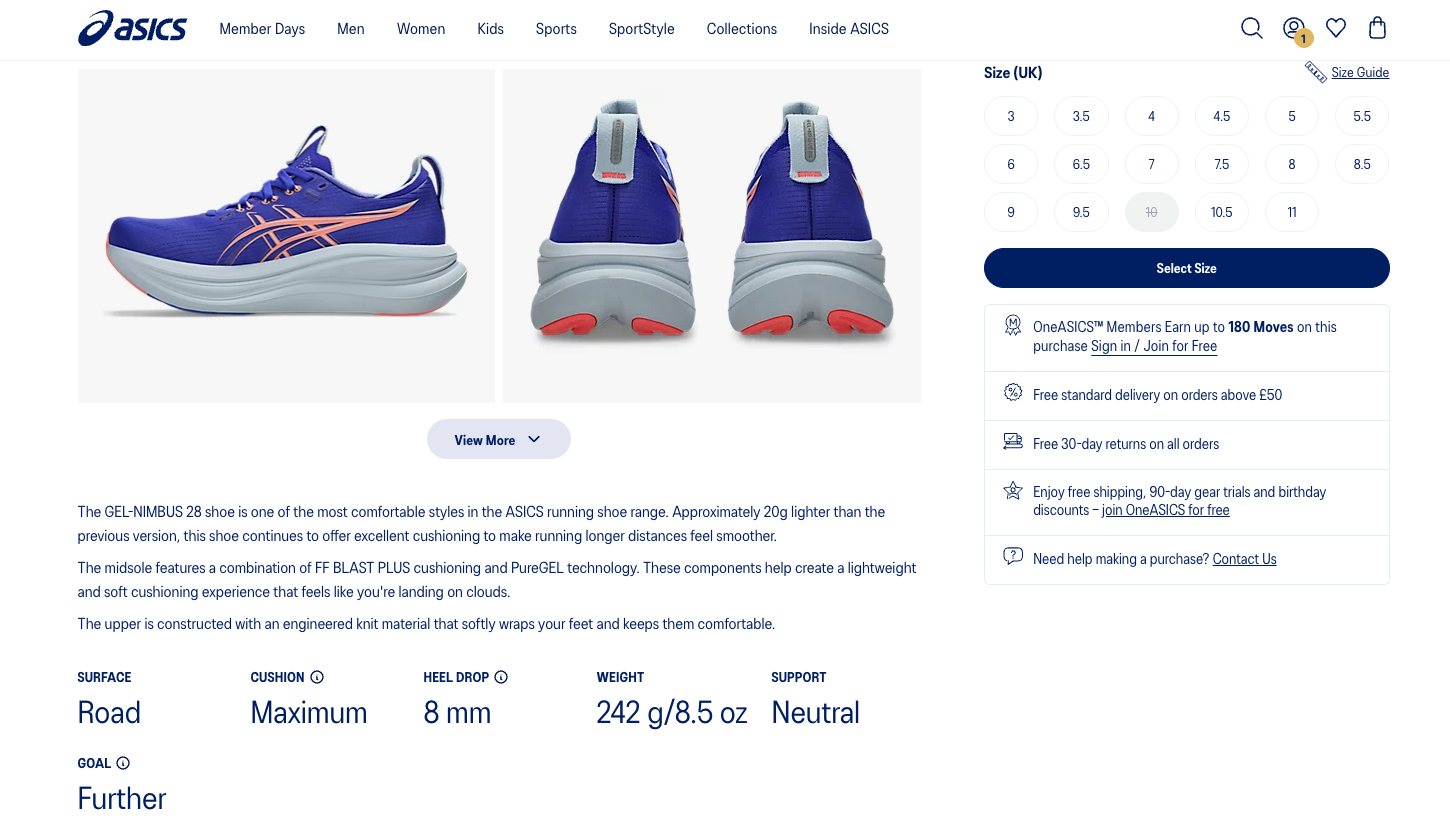
These running shoes show why an AI shopping assistant needs more than a product name and description. On its women’s GEL-NIMBUS 28 product page, ASICS identifies the shoe as suitable for road running, with maximum cushioning and neutral support. It also lists an 8 mm heel drop and a weight of 242 g, along with the selected width, colour, and available size choices.
These details help an assistant answer a specific request, such as finding a cushioned road shoe for a neutral runner. Before recommending a particular pair for purchase, it also needs reliable information about the chosen size’s stock, current price, and delivery options. For brands, the practical check is whether the product page, structured data and product feed provide the same information for that exact variant.
ASICS presents terrain, cushioning, support and numerical specifications on the GEL-NIMBUS 28 product page. An assistant also needs current variant and fulfilment data to assess a specific purchase.
Image of the product page captured on 30 September 2026; prices, availability and policies can change.
Why should brands be paying attention to this?
So, what’s the risk for brands who do nothing as agentic shopping develops? Even though some users will still want to shop for themselves through traditional search means, agentic shopping is growing.
To really emphasise how agentic shopping is already scaling: Salesforce research found that agentic search is already fast becoming the first step in a purchase journey. In the UK, research found 64% of participants want to use agentic AI for shopping, especially for its functionality to compare product options and find a specific product.
Brands can miss out on relatively straightforward sales if their product data isn’t clear, complete and consistent. Think of it like this: this information should already be there and accurate.
Remember, your products can still be visible in organic results with missing data. However, an AI agent may not show them at all. It’s also an opportunity for retailers to leapfrog over the brands they sell. The same product can be surfaced in agentic shopping, but from another retailer if their product data is better optimised.
What can brands do to prepare for agentic shopping?
To get ahead of agentic shopping, what can brands do? There’s no separate playbook for AI agents. Instead, we suggest taking a more holistic approach that will put you on a good footing for agentic shopping, as well as user experience, traditional search and AI Overviews.
Here are the four steps we recommend:
- Prepare a PDP audit and strategy that prioritises your brand’s hero products. This means you won’t be overwhelmed by a large number of products and can focus your attention on where you make most of your sales.
- Audit this product information across three layers: visible content, structured data, and product feeds.
- Then, ensure prices, product features, attributes, variants, and stock information match across all channels.
- Verify that structured data and product feeds tell exactly the same story about products.
Conclusion
Preparing for the wider scaling of agentic shopping depends on understanding how AI agents parse and appraise product data, not only to make recommendations but also to make purchases on behalf of users.
Knowing how it works means understanding the importance of staying on top of product feeds, structured data, PDPs, and website information, and ensuring they’re complete, consistent, and clear. This is all information your brand should already have; it’s just a question of keeping it in check.
If you are feeling a little lost on how to prepare your brand for agentic shopping, feel free to contact us.