PDP Discoverability: SEO that wins in Search, Shopping & LLMs

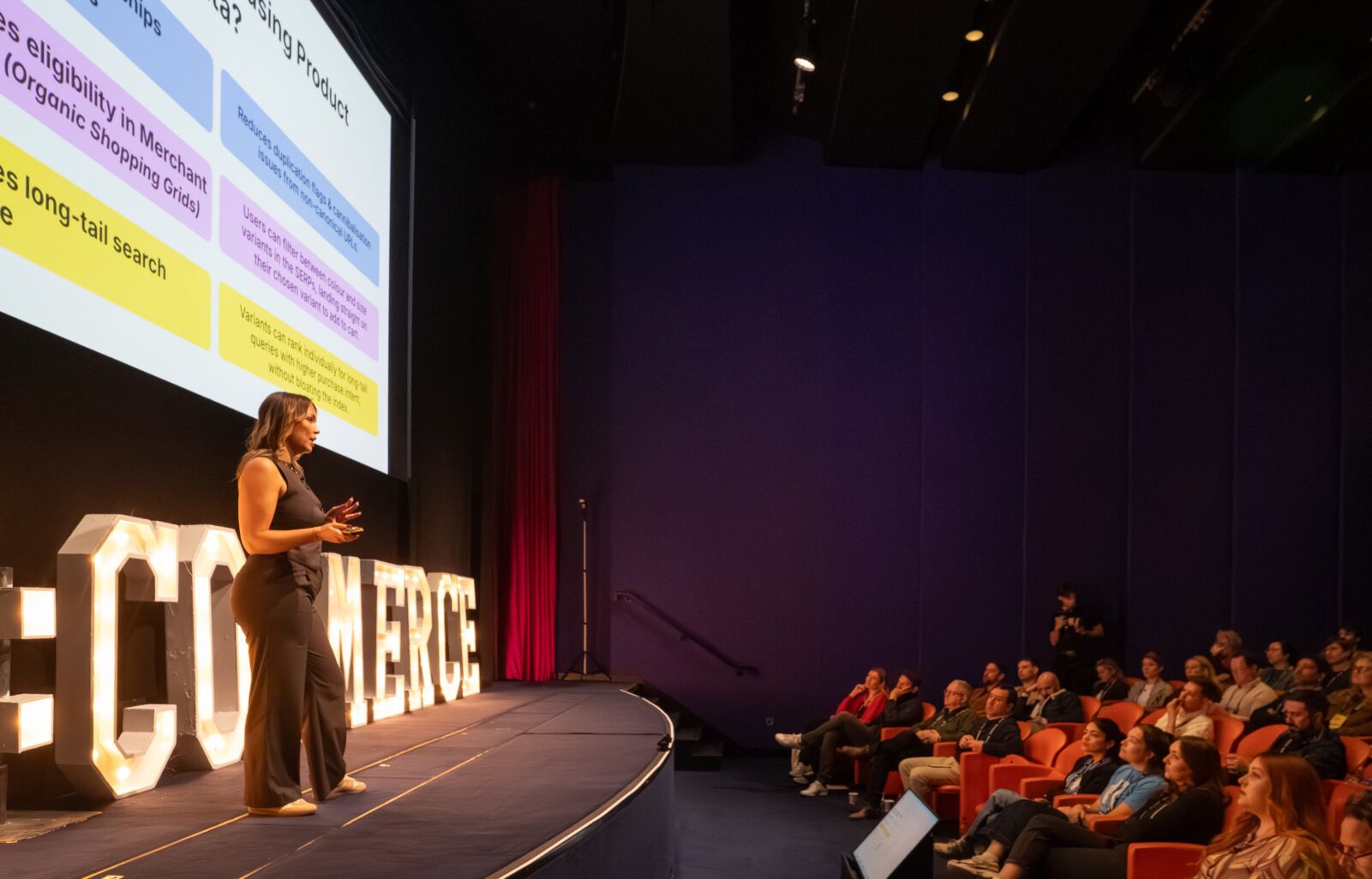
Based on a presentation “PDP Discoverability in 2026: Technical SEO that Wins in Search, Shopping & LLMs” by Amanda Beales, Head of Organic Search at Resignal delivered at Re:commerce 2026
For years, standard eCommerce product discoverability relied on a familiar playbook: descriptive titles, clean canonical tags, basic product Schema, competitive pricing, and the flow of brand authority through digital PR. But in 2026, getting these basics right is no longer enough.
Even mature eCommerce websites with solid foundations are struggling with volatile search engine results page (SERP) visibility, missing rich snippets, and inconsistent inclusion in Large Language Model (LLM) chat retrievals. The landscape has shifted fundamentally, and our technical strategy must shift with it.
The PDP Discoverability Shift: What’s Changed?
The product discovery landscape in search has transformed rapidly over the past few years, with more and more features introduced into the SERPs that act as key levers for driving revenue through PDPs. Compounded by the growing usage of LLMs for product recommendation, product optimisation has become more valuable than ever before.
Some of the key landscape changes that have occurred:
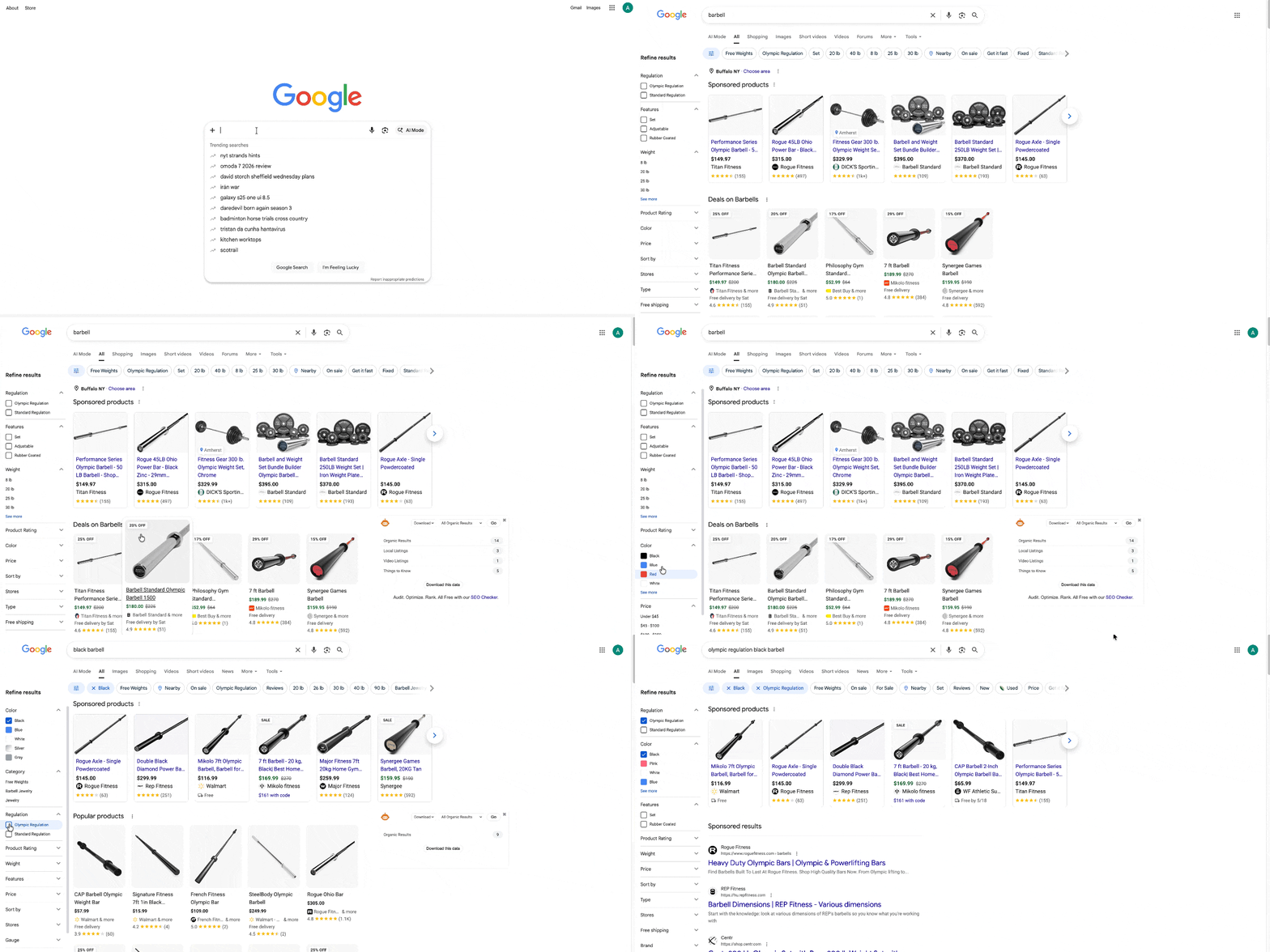
- In-SERP filtering: Search layouts for commercial queries have been shifting towards an interactive, faceted navigation-style environment. Users searching for general terms with even just a glimmer of commercial relevancy are often being greeted with filtering capabilities on the left side of the SERP. Interacting with these options appends variables to the query, filtering results entirely within the engine. This effectively turns the SERP into a category page.
Currently dominant in the US, this infrastructure is expanding rapidly into the UK and EU.
- Commercial Explosion of AI Overviews: While initially introduced for more information queries, AI Overviews have experienced as high as triple-digit growth in commercial query coverage over the last six to nine months. While the placement of these overviews are often below the fold (i.e. within one desktop or two mobile scrolls), these frequently capture high-intent traffic that would have previously been steered towards text or shopping results.
- The Rise of Organic Shopping Grids: Merchant listings (also referred to widely as organic product grids) were once restricted to the “Shopping” tab in browser search. However, in the last two years these have migrated directly onto the main “All Results” tab, and have been growing at a huge rate, making the adoption of Merchant Center and Variant Schema even more critical for success organically.
- Agentic Checkout Ecosystems: It was once unthinkable that a customer might be able to purchase a product from a retailer without ever visiting their website. But OpenAI’s agentic checkout protocol (ACP) turned that notion completely on its head.
ChatGPT originally announced back in 2025 that their 900m monthly users would be able to shop and purchase products directly in the chat interface through “Buy in ChatGPT”. Google’s version, universal checkout protocol (UCP) allows users to buy products without ever leaving the SERP, and can even consolidate shopping carts across multiple retailers to take place in just one transaction.
While GPT has since halted progress of their checkout feature to focus on product discovery through the tool instead, Google’s UCP is now partially live and pending full-scale rollout.
The impact of these advancements and the reality of 2026 is that the risk of revenue loss from lack of PDP discoverability has never been higher than it is today.
The good news is that there are a few key technical enhancements you can make to ensure your products are primed for discovery and data extraction:
- Structured product groups: from ‘a product page’ → product systems through Schema
- Consistent product identity: your product must say the same thing everywhere
- Rendered accessibility: if it’s not in the HTML, it’s not guaranteed to exist
- Internal architecture: strengthened linking structure to drive discovery
Technical Optimisation 1: Implementing Structured Product Groups
eCommerce sites often feature products with multiple options to build up the final offering, known as variants. These can be anything from standard variations like size, colour or material, to things like flavours for consumable goods, formats for DVDs, books or file types, scents for candles, etc. Often, these variations are housed under separate or parameterised URLs, which often contain near-identical content and therefore trigger duplication or canonical issues.
But with the use of ProductGroup Schema, crawlers can now understand the relationships between these variants better, to minimise conflicts and establish a product system between the options that works much better in the discovery journey.
In a nutshell, product variant markup provides explicit semantic context to crawlers regarding variant relationships under a single, overarching parent structure.
Moving to this framework can deliver immediate strategic advantages:
- Eliminating Cannibalisation: It establishes explicit parent-child matrices, mitigating duplication and internal ranking conflicts between highly similar products on your website.
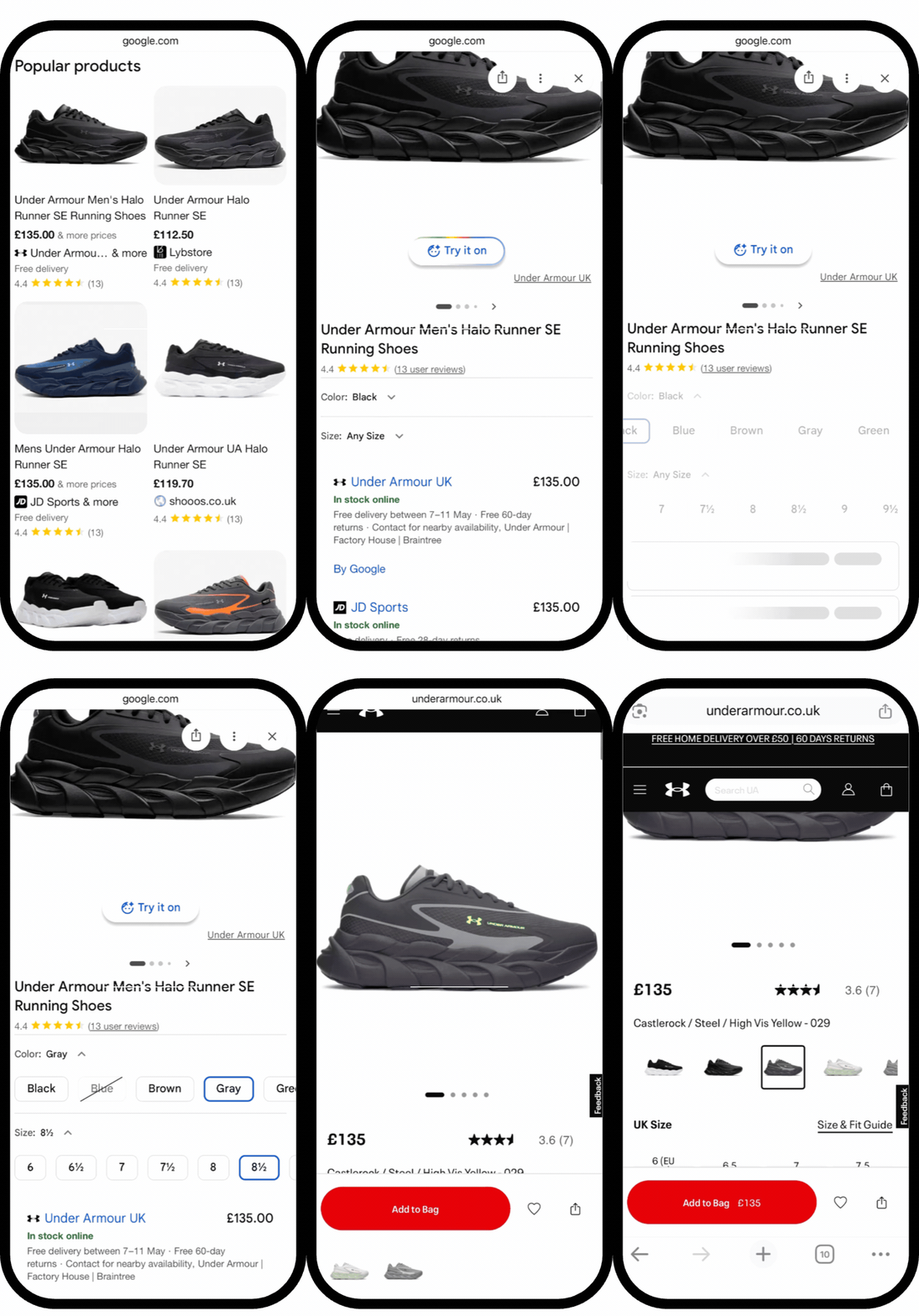
- Direct SERP Filtering Eligibility: It qualifies variants for organic shopping grids and allows users to filter options within the search page, landing them directly on a pre-selected variant page ready to “add to basket”.
- Dominating Long-Tail Queries: Variants gain the technical authority to rank individually for highly specific, long-tail queries with higher purchase intent, while safely retaining their equity connection to the parent product.
Two Architectural Roads to Variant Schema
Depending on your technical stack, variant systems generally follow one of two patterns:
- Single-Page Variants (Highly Preferred): All variants are housed within our core product page. On this page, interactive filtering dynamically updates the URL through URL parameters. These parameterised variant URLs must canonicalise back to the primary parent product URL. This cleanly consolidates page authority under one roof.
- Multi-Page Variants (Supported): Each variant exists as a separate, unique product page. In this instance, each URL carries its own unique self-referencing canonical tags, and link distribution is split equally across the group.
Top tips for enhancement:
- When a user lands on a parameterised variant URL from the SERP, you should dynamically alter the on-page experience to match the variant the user has clicked on. This means pre-selected dropdowns, hero images that match, and pricing data reflective of the option chosen.
- Mirror changes in your Schema markup, not just for mandatory fields like price and URL, but for descriptive fields too i.e. if a variant is marked “Black,” the title and description tags extracted by the crawler should include that variant attribute.
Find out more about the technical requirements for variant Schema using Google’s developer guidelines.
Technical Optimisation 2: Bulletproofing Identity Consistency
Organic shopping grids rely heavily on three core first-party data inputs.
- On-Page Experience: The visible, hardcoded text and assets on the PDP.
- Structured Data: The embedded microdata or JSON-LD Schema layers.
- Merchant Feed: The data catalogue directly submitted via Google Merchant Center.
If these sources conflict, crawlers can lose trust in the information you’re giving them, resulting in suppressed rich results, merchant feed disapprovals, or third-party retailers capturing your brand’s prime real estate.
If other retailers are also selling your products, this information is also likely to be used as part of the organic grid data population. So making sure your first-party data is detailed and well-optimised is the best way to make sure the data shown to a customer is accurate and taken from your website as opposed to an alternative source.
To maintain consistency at scale across different operational teams (Product, Development, Paid Ads, and SEO), it’s a good idea to utilise a centralised Product Information Management (PIM) system. A PIM acts as your single source of truth, distributing uniform data straight to your CMS, which can in turn be used to populate Schema markup, and merchant feed data sources.
When optimising or modifying data supplied to Google Merchant Center, you should always preserve your primary feed data to maintain this one source of truth. You can instead use supplemental feeds to inject optimisations without tampering with your core data source.
The Inconsistency Audit Toolkit
- Screaming Frog SEO Spider: Use the custom structured data extraction settings to pull and cross-reference Schema properties against page content at scale.
- Cloud-Based Crawling: Automate and schedule large-scale crawls off-machine to monitor data changes without impacting daily operations or machine speed. This can easily be done using Screaming Frog via a virtual machine (if you have access to one).
- GSC & Merchant Center Diagnostics: Leverage the Merchant Listings reports inside Google Search Console, alongside the diagnostic alerts in Merchant Center, to catch values mismatches immediately.
Technical Optimisation 3: Hardcoding What Matters (The Rendering Reality)
A simple, absolute rule governs search optimisation in 2026: If a piece of information does not exist within the raw HTML, it is not guaranteed to exist in the eyes of a crawler.
While standard search engines will eventually pass pages through a JavaScript rendering queue, this process introduces significant friction. Pages can sit in rendering queues for a largely unknown duration, during which search engines only analyse the more basic, unrendered HTML version of your site. Even worse, search engines regularly skip rendering or partially truncate scripts at scale if execution times are too high.
This means that if critical commercial information relies entirely on client-side scripts, it could be being missed for immediate indexing.
For LLM user agents (such as OpenAI’s GPTBot), the likelihood of your JavaScript rendered content being seen is even less. LLMs do not typically execute client-side JavaScript, so if your product content relies on script rendering, an LLM agent viewing your page is more likely to exclude your content in chat retrievals.
The SSR Imperative: Critical Fields to Hardcode
To ensure reliable data extraction by all crawlers and LLMs, use Server-Side Rendering (SSR) to hardcode critical information:
- Tier 1 (Core Fields): Product Name, Description, Pricing, Stock Status, and Canonical Tags.
- Tier 2 (Conversion Signals): Internal linking pathways, Shipping & Returns information, Add-to-Cart buttons, Product Images, User Reviews, Accordion FAQs, and Related Product blocks.
(Tip: You can audit this yourself by disabling JavaScript in Chrome DevTools to see exactly what content disappears, using CTRL+Shift+P on an android or CMD+Shift+P on a mac. A site with an excellent rendering setup, like Sigma Sports as seen below, won’t lose its core text and assets when JS is turned off).

Technical Optimisation 4: Harnessing the Power of Internal Linking
Internal linking remains the most reliable method of URL discovery. This is something that Google has confirmed themselves many times, but it’s also critical for LLMs.
When an LLM user agent fulfils a prompt, it relies heavily on two primary lookup mechanisms, both of which are anchored directly to site architecture:
- Index Sampling: The agent issues a programmatic search query, isolates the top-ranking results in the index, and reads the content on the page. This is then chunked into content blocks (or embeddings) and used for retrieval in LLMs. Strong internal linking elevates your pages into this top-tier index footprint.
- Direct Menu Navigation Trawling: The agent goes directly to a target domain and traverses the core menu navigation. The hierarchy patterns, directory folders, and anchor text is decoded and mapped back to keywords within the user query to isolate answers. This is directly based on the internal linking structure.
To maximise your internal linking pathways, anchor all main navigation routes around canonical URLs and parent SKUs. Ensure high-revenue PDP links sit directly on the primary page of your category grids, and that the pages that house those PDPs are also prioritised in linking structure.
It’s also key to ensure you follow pagination best practice. This means never allowing secondary pagination pages (e.g., page 2, 3, or 4) to canonicalise back to page 1; doing so blocks crawlers from discovering deep inventory links and may result in your secondary products being missed. Always build links via standard HTML <a href=”…”> tags rather than script-driven click events so they remain crawlable.
Sitemap Optimisation Secrets
While sitemaps aren’t strictly a method of internal linking, they are still important for discovery. Go beyond passive XML sitemaps by implementing a two-tier architectural layout:
- Primary Sitemap: Dedicated exclusively to your highest-priority, high-performing canonical PDP URLs.
- Secondary Sitemap: Houses long-tail or secondary products.
This structure gives search engines an explicit roadmap of what to prioritise first. Finally, it’s good to maintain an accurate, dynamic <lastmod> tag. Updating this field provides an immediate date flag to crawlers, meaning your new content is likely to be discovered more quickly.
The PDP Maturity Model: Your North Star
To stay competitive, evaluate your inventory using the PDP Maturity Model to optimise for complete data extraction:
- Tier 1: The Crawlable Foundation (The Basics) – Standard descriptive copy, basic single-product Schemas, indexation rules, canonical tags, and domain authority.
- Tier 2: The Structured Network (Advanced Schema) – Unified data streams across PIM/CMS, robust implementation of ProductGroup Schemas, and zero data friction across feeds.
- Tier 3: The Omnipresent PDP (AI & LLM Ready) – Full Server-Side Rendering (SSR) for all critical assets, hyper-optimised internal linking maps, segregated priority sitemaps, and absolute readiness for conversational and agentic commerce platforms.
